
7 Best CO2 Monitors and Air Quality Sensors for Home & Office
- Updated on: January 31, 2025
30 percent of new and remodeled buildings in America show all the signs of poor indoor air quality, says the Consumer Product Safety Commission. There are many studies proving the impact air quality has on productivity and health. A worrying sign is an existence of SBS (sick building syndrome) proving that bad air quality can manifest in many ways besides loss of productivity – from headaches to respiratory problems.
We may think that it is the polluted city air that is the worst one for our health, but we may be mistaken. According to the US Environmental Protection Agency (EPA), air pollution indoors is often between two and five times greater than outdoors – and can get at its extreme up to 100 times worse than the open air.
While the polluted air outdoors is easily detectable by its look, smell, and even taste of it, air pollution indoors is hard to detect without a proper device. Healthy working and living conditions are essential for your well-being, cognitive functions and overall productivity, these monitors are your tools to help reduce healt risks and potential visrus transmissions. To help you make the decision on which air quality and CO2 monitor to choose, here are our 7 top performing air quality sensors for your home or office!
7 Best CO2 Sensors and Air Quality Monitors for Home and Office

Source: Luxafor – Luxafor CO2 Monitor
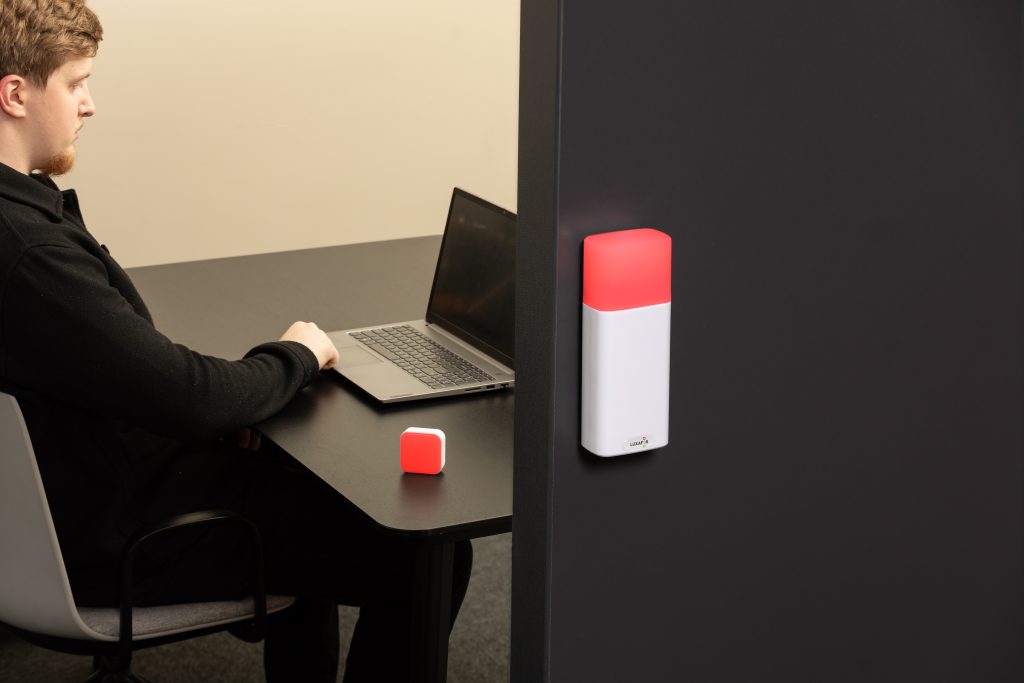
It’s tiny and functional, it’s wireless and portable, and it’s capable of a lot. Luxafor CO2 Monitor is an environment monitor that measures the office microclimate – humidity, CO2, temperature, noise, and lighting – relevant to productive work. The e-ink display shows what should be improved to achieve the perfect environmental conditions in your workplace for better health and higher productivity. Besides its powerful sensor for detecting CO2 and temperature which are typical features of any other CO2 meters out there, it gives you noise and lighting levels of an individual workspace to understand the other very important factors that influence our productivity at work.

Source: Luxafor – Luxafor CO2 Monitor
This comparatively weightless device is a solid choice for offices that want to increase the long-term productivity of the team, as healthy workers are proven to be more productive in a healthy environment, which leads to a better work ethic and higher quality of life. We’re not just saying this because we created it. It’s because we created it to be the most optimal way how to measure and improve the indoor air quality and most important environmental conditions in your office.
2. Gain Express Indoor Air Quality Tester

Although it looks like a retro Nokia, this air quality tester really comes in handy for measuring CO2 levels, temperature, and humidity. The NDIR sensor claims to provide very accurate readings so the device is also compatible with reading the environmental conditions in an office, as well as a lab. A great plus is that it has a high battery life due to its efficient circuitry.
3. Inkbird Air Quality Monitor

Source: Amazon – INKBIRD CO2 Detector
A bit like an upgrade to the previous listing, this multi-functional air quality monitor has laser particle and CO2 sensors that provide accurate readings. Although the device is on the higher end in terms of price, the monitor displays readings in an easy-to-understand way. The alarm function comes in handy to notify when CO2 reaches or maxes out a set limit.
4. Perfect-Prime Indoor Air Quality Meter

This monitor measures CO2 levels in a wide range up to 9999 ppm and logs about 12’700 readings. What’s also great is that it logs other readings as well such as temperature (14-158 F) and humidity. Charge it through a standard USB cable, compatible with a mobile phone power bank and charger, and you’re good to go.
5. GZAIR Wall Mountable Carbon Dioxide Detector

This wall-mountable CO2 meter is a professional device for measuring air quality practically anywhere where CO2 has typically generated at high levels: schools, office buildings, hotels, and even greenhouses. The separate detection modes for people and plants have different ranges to detect the best possible conditions for your office workers as well as your office plants.
6. Hydrofarm Autopilot Desktop CO2 Monitor & Data Logger

This CO2 monitor also gives readings of relative humidity and temperature on a bright and clear display. The trend chart shows the variable readings of these parameters, helping you to see the pattern of how they change during weeks or hours, even. An audible alarm signal you of CO2 levels that are too low or too high.
7. Yvelines Air Quality Monitor
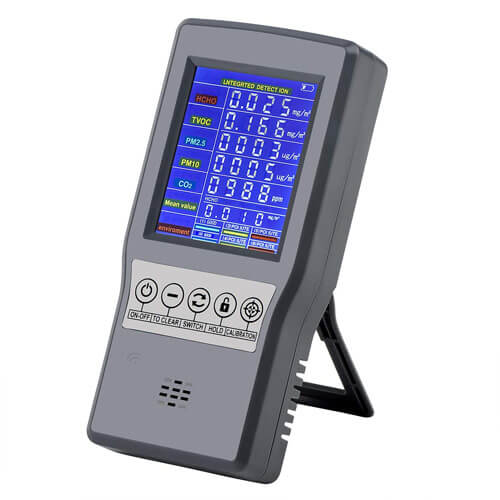
This monitor by Yvelines comes in very handy if your office is exposed to more toxic nearby chemicals. Besides measuring CO2 with top-notch accuracy, it is also capable of detecting formaldehyde, toluene, harmful chemical substances, and pollutants such as carbon monoxide, smoke, fog, dust, alcohol, glue, paint, ink, and others. Portable and equipped with a rechargeable battery, it is a great choice for offices near or next to the factory area.
Our final thoughts
Although most CO2 monitors fall in the price range of $90-170, there are certain nuances that each device does. To make the final conclusion over which air quality and CO2 monitor to pick for your office, it all pretty much depends on the gravity of the issue. If you feel like you and your coworkers are exposed to chemicals and toxic particles, then definitely go for the more professional ones to reduce any potential health risks. Likewise, a more precise sensor will be necessary to detect minute fluctuations in environmental conditions.
However, if you’re looking for a simple CO2 sensor that looks discreet and does a great job to provide you with accurate readings of CO2, temperature, humidity, light, and noise, why not give Luxafor CO2 monitor a try?
Do you want to build and maintain new habits? Get your free PDF version of the Don't Break The Chain calendar and start today!
Do you want to build and maintain new habits? Get your free PDF version of the Don't Break The Chain calendar and start today!
Our final thoughts
A CO2 sensor, also known as a carbon dioxide sensor, is a device designed to measure and monitor the concentration of carbon dioxide gas (CO2) in the surrounding environment. CO2 is a colorless and odorless gas, so you can't detect it with your senses. These sensors are important because high CO2 levels can be harmful to human health.
There are two main types of CO2 sensors:
NDIR (non-dispersive infrared) sensors: These sensors use infrared light to measure CO2 levels. They are the most accurate and reliable type of CO2 sensor.
Electrochemical sensors: These sensors use a chemical reaction to measure CO2 levels. They are less accurate than NDIR sensors, but they are less expensive.
Measuring CO2 levels provides valuable information about the quality of your environment, allowing you to take steps to improve air quality, health, productivity, and potentially even save energy.
There are several reasons why measuring CO2 levels can be beneficial:
Improved Health and Productivity: High CO2 levels can lead to drowsiness, headaches, and difficulty concentrating. By monitoring CO2, you can ensure proper ventilation, reducing these effects and creating a more comfortable and productive environment for people in the space.
Reduced Risk of Airborne Virus Transmission: CO2 buildup is an indicator of poor ventilation, which can also trap airborne particles like viruses. Monitoring CO2 helps identify areas needing improved ventilation to potentially reduce the spread of viruses.
Energy Efficiency: In colder climates, maintaining good ventilation to remove CO2 can lead to energy waste. CO2 monitors can help find a balance between adequate ventilation for health and minimizing energy use for heating .
Safety in Specific Environments: In certain workplaces like breweries or labs, CO2 levels can reach dangerous concentrations. CO2 monitors can be crucial for safety in these settings to prevent accidents
Optimal working conditions encompass two main aspects: physical environment and work culture, the main environmental factors are:
- Ergonomics: A well-designed workstation with an adjustable chair, proper monitor height, and adequate legroom reduces strain and discomfort.
- Lighting: Balanced lighting that avoids glare and provides enough illumination for the tasks at hand minimizes eye strain and fatigue.
- Temperature: A comfortable temperature range, typically between 68-72°F (20-22°C), promotes focus and well-being.
- Air Quality: Maintaining good ventilation with moderate CO2 levels ensures a healthy and fresh environment for better concentration and reduced health risks.
Author

Kaspars S.
Productivity tool developer, corporate leader, and technical director at Luxafor
7 Best CO2 Monitors and Air Quality Sensors for Home & Office

Busy Tag – Your Digital Canvas
Tags
Archives
- June 2026
- May 2026
- March 2026
- January 2026
- December 2025
- November 2025
- October 2025
- September 2025
- August 2025
- July 2025
- June 2025
- May 2025
- February 2025
- January 2025
- December 2024
- November 2024
- October 2024
- September 2024
- August 2024
- July 2024
- June 2024
- May 2024
- April 2024
- March 2024
- February 2024
- January 2024
- December 2023
- November 2023
- October 2023
- September 2023
- August 2023
- July 2023
- June 2023
- May 2023
- April 2023
- March 2023
- February 2023
- January 2023
- December 2022
- November 2022
- October 2022
- September 2022
- August 2022
- July 2022
- June 2022
- May 2022
- April 2022
- March 2022
- February 2022
- January 2022
- December 2021
- November 2021
- October 2021
- September 2021
- August 2021
- July 2021
- June 2021
- May 2021
- April 2021
- March 2021
- February 2021
- January 2021
- December 2020
- November 2020
- October 2020
- September 2020
- August 2020
- July 2020
- June 2020
- May 2020
- April 2020
- March 2020
- December 2019
- November 2019
- October 2019
- September 2019
- August 2019
- July 2019
- April 2019
- March 2019
- January 2019
- December 2018
- November 2018
- October 2018
- September 2018
- August 2018
- July 2018
- June 2018
- August 2017
- May 2017
- April 2017
- February 2017
- January 2017
- November 2016
- October 2016
- September 2016
- August 2016
- July 2016
- June 2016
- May 2016
- April 2016
- March 2016
- February 2016
- January 2016