
5 Methods of Avoiding Burnout When Working From Home
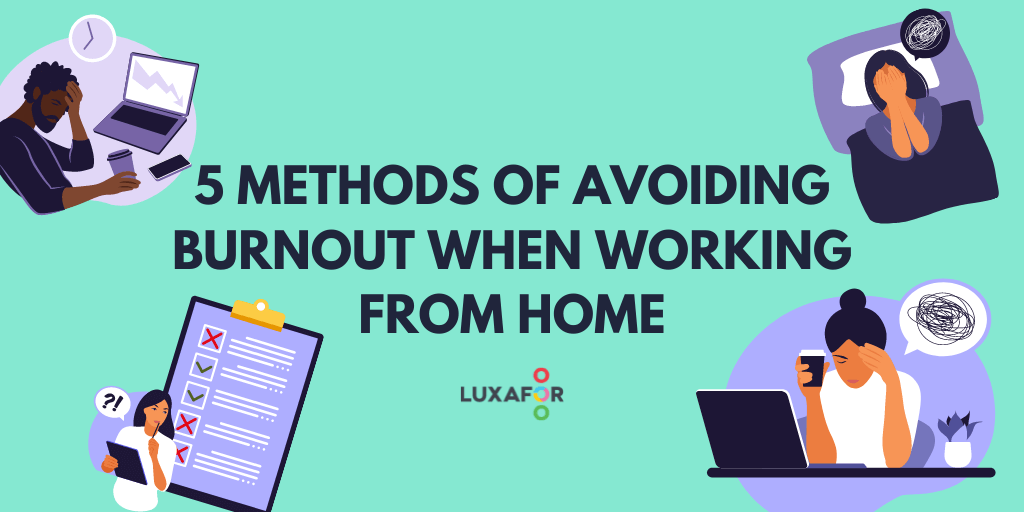
In the past year, due to the COVID-19 pandemic, many office workers have become familiar with working from home for the first time. As time passed, what started out as a dream for many workers turned into a total drag. While it has its perks of increased comfort and a lack of time and money wasted on commuting, working from home still presents a unique set of challenges. For some, it means more distraction by family members or children and for others, it means total isolation. It has become increasingly apparent that work without office culture and separation of home and office space could result in a phenomenon called “burnout”.
What is burnout?
Burnout is a product of job-related stress that presents itself as physical and/or emotional exhaustion often resulting in reduced productivity, a sense of apathy, or feelings of insignificance, and sometimes loss of personal identity. “Burnout” is not an official medical disorder, but rather an emotional or mental state that many are able to easily recognize.
So how can you avoid or overcome burnout? Consider the following tips if you are working from home or are experiencing the feeling of burnout in relation to your job.

Source: Unsplash
Develop boundaries
Some people who work from home find that they have a better work-life balance because they have time freed from a commute or time spent getting fully dressed up in office attire every day. Others, especially those in more demanding managerial positions, may find their work-life balance diminished with no clear boundary between home and the office. This causes one to feel like they are at work or on call at all hours. In that environment, one is highly likely to experience burnout.
The first, most basic boundary you can set in place is committing to not check work email outside of working hours, and ask that if there is an emergency that someone calls you. Even better is to take your work email off your personal phone if you can. It’s also best to talk with a manager or human resources (HR) administrator about setting boundaries so you can sync your expectations.
A second step is to try and work in a separate space than you spend your free time at home. An office is ideal because you can shut the door and create a mental distinction between work and home, but if that’s not feasible try to refrain from working on the couch or in bed in preference for a desk or table. Some people have even found that reincorporating a “commute” back into their schedule helps them create that mental distinction. This means taking a walk just before and/or after work or driving for a coffee before you start your day, breaking the monotony and the blurred lines between life and work.
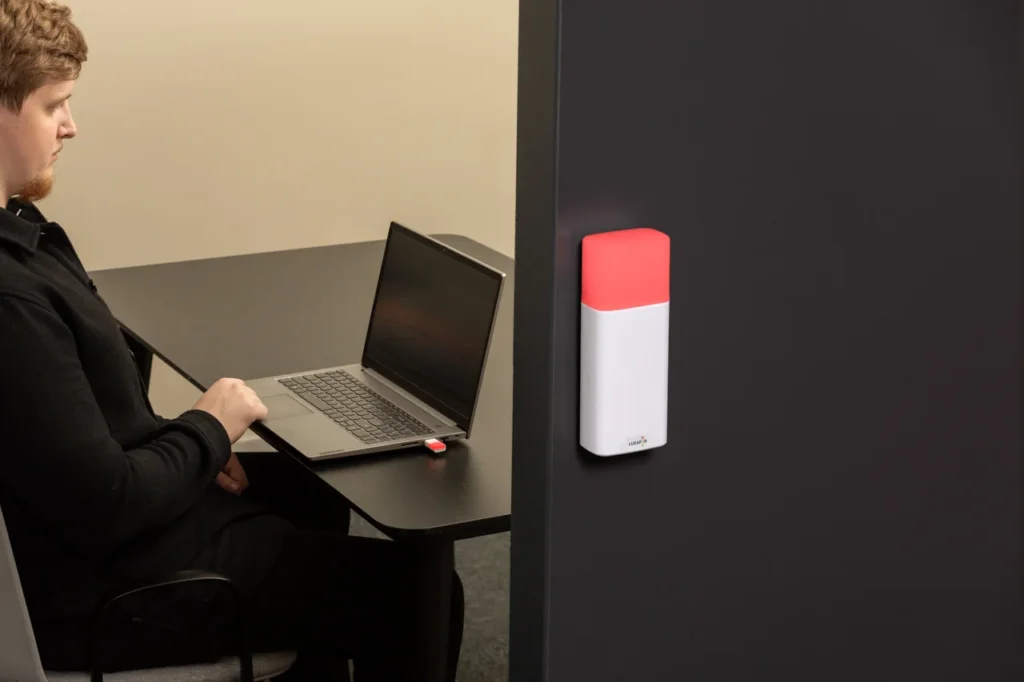
Lastly, if you find yourself constantly being interrupted by family or roommates, it’s a great idea to consider using a tool like the Luxafor Flag to signify when you can or cannot be interrupted. The Luxafor flag is a simple light clip that you can place on your computer displaying a green or red light. Many parents find it extremely helpful if they experience regular non-urgent interruptions from their children.

Reach out to colleagues or friends
Working from home lacks social support or stimulation. Without the casual office “water cooler chat,” work can feel dull and uninspiring. Consider reaching out to colleagues, friends, and family. Even if it’s outside of work, having social support in your life can help you from feeling so isolated at home.
For example, try meeting up with a friend or colleague for coffee or lunch throughout the week. This small break will instill a sense of normalcy and help split up the week so that you don’t feel like you’re only socializing on, or waiting for, the weekend. It’s also a great idea to make these events routine so that it’s an effortless part of your schedule.
In addition, if your company allows it you could schedule a quick weekly meeting with your colleagues just for fun and learning about each other. This is the most viable alternative to “water cooler chat” in a virtual environment. It’s also a great way to brainstorm new ideas or initiatives for your projects. Creativity is often stifled under pressure, so these meetings shouldn’t be thought of as wasted time.
Find ways to avoid monotony
Without a change of location or any social stimulation, every day can feel exactly the same and lead to boredom and apathy. It’s best to find small ways to change up your daily routine. If you have mundane or routine computer tasks in your day, listening to podcasts or music in the background can help.
Also, refrain from eating lunch at your desk every day. Taking scheduled breaks should be encouraged by your work, especially for meals. In an office environment you would likely be interrupted by coworkers throughout the day so refrain from feeling guilty about taking a few minutes for yourself. Regular small breaks are proven to increase productivity.
Better yet, you can utilize a tool like the Luxafor Pomodoro timer to methodize your breaks. The pomodoro method of time management, which involves scheduling 25 minutes of uninterrupted work broken up by 5 minutes of break time, has been found to be an effective means of increasing productivity. The Luxafor Pomodoro timer is a small USB-powered device that gives you visual cues of the start and end of your breaks.

Source: Unsplash
Avoid Zoom fatigue
Many people find themselves in back-to-back virtual meetings all day when working from home. This new experience has led to a phenomenon now widely recognized as “Zoom fatigue,” or mental exhaustion resulting from virtual meetings.
This fatigue is more severe than in-person meetings because the cognitive load is higher in video chats due to intense close-up eye contact, but luckily, there are ways to work around this. When scheduling virtual meetings, first ask yourself if the meeting is truly necessary and if so, schedule wisely.
Google has developed a feature called “speedy meetings” on their calendar where it automatically schedules virtual meetings to end 5-10 minutes earlier to allow for breaks in between back-to-back meetings. Try adopting this practice when scheduling your meetings, as well as turning off your video every once in a while to allow yourself some privacy. Prolonged Zoom fatigue can contribute to burnout, so developing some standards can help you greatly.
Reach out for help
If you find yourself still struggling even after implementing changes, you may need more help or support to help you bounce back from burnout. It will look different for everyone.
For some, this could look like talking to your HR administrator to figure out more systematic changes. For example, options such as flex hours or allowing personal time for a mental health break. For others, it could look like getting more help from a mental health professional. Even in a pandemic, there are options such as online therapy services that are more quick and convenient for working people and parents. These options make it easy to reach out for help from the privacy and comfortability of your own home, which is especially important during the pandemic.
It’s also a great idea to discuss your mental health with your family. If your home life demands a lot from you, those demands in combination with work can contribute to overwhelm and burnout. Perhaps your family can help with daily chores and tasks that can free some responsibilities from your plate.
In the end, burnout is unfortunately common, but there are many preventive measures to either avoid or come back from this negative mental state. Burnout doesn’t only affect your work, but your entire life from your relationships to overall life satisfaction. Consider taking some of the actionable steps above to make sure you are setting yourself up for success.
Do you want to build and maintain new habits? Get your free PDF version of the Don't Break The Chain calendar and start today!
Do you want to build and maintain new habits? Get your free PDF version of the Don't Break The Chain calendar and start today!
Author's Bio
Chelsea Whitman is a professional writer who specializes in topics like personal development, productivity, self-growth, and continuing education.
5 Methods of Avoiding Burnout When Working From Home





Tags
Archives
- June 2026
- May 2026
- March 2026
- January 2026
- December 2025
- November 2025
- October 2025
- September 2025
- August 2025
- July 2025
- June 2025
- May 2025
- February 2025
- January 2025
- December 2024
- November 2024
- October 2024
- September 2024
- August 2024
- July 2024
- June 2024
- May 2024
- April 2024
- March 2024
- February 2024
- January 2024
- December 2023
- November 2023
- October 2023
- September 2023
- August 2023
- July 2023
- June 2023
- May 2023
- April 2023
- March 2023
- February 2023
- January 2023
- December 2022
- November 2022
- October 2022
- September 2022
- August 2022
- July 2022
- June 2022
- May 2022
- April 2022
- March 2022
- February 2022
- January 2022
- December 2021
- November 2021
- October 2021
- September 2021
- August 2021
- July 2021
- June 2021
- May 2021
- April 2021
- March 2021
- February 2021
- January 2021
- December 2020
- November 2020
- October 2020
- September 2020
- August 2020
- July 2020
- June 2020
- May 2020
- April 2020
- March 2020
- December 2019
- November 2019
- October 2019
- September 2019
- August 2019
- July 2019
- April 2019
- March 2019
- January 2019
- December 2018
- November 2018
- October 2018
- September 2018
- August 2018
- July 2018
- June 2018
- August 2017
- May 2017
- April 2017
- February 2017
- January 2017
- November 2016
- October 2016
- September 2016
- August 2016
- July 2016
- June 2016
- May 2016
- April 2016
- March 2016
- February 2016
- January 2016