
Benefits of Games For The Workspace
- Updated on: February 3, 2025
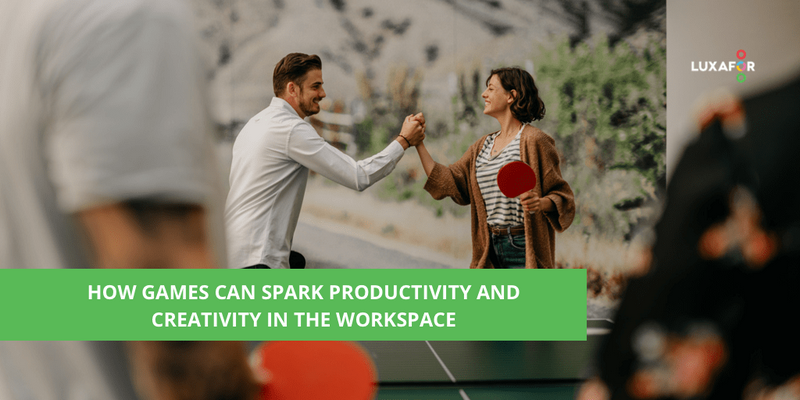
When other employees catch a glimpse of a person playing video games instead of working, some think he’s wasting time. But little do they know that the five-minute of your favorite game helps unwind and provides the kind of passive-thinking time individual needs to solve problems and be more efficient.
People react normally to people smoking, which damages the lungs – actively of a person that does that, passively those around. Though somehow playing games seem to be more time-wasting and unproductive in people’s opinion… Let’s see what is true.
A bit of backstory
Prolonged working — often over 100 hours a week — makes receiving information later in the day more challenging, and using time for video game breaks helps to chill and gain motivation, providing more vitality to work further into the evening.
Many employees bring their video gaming interests to work because long hours and project-based work allow them to fit in a few minutes of playtime during the workday.
Science indicates that they could be onto something. Psychologists and gamers agree that the advantages extend above and beyond mere entertainment. Many people use playing video games to relieve stress during work, to cope with a monotonous position, or to experience more authority. Unlike scrolling through Facebook or perusing the internet, the games are entirely captivating and even provide us with a digital morale boost that we may not get in our day-to-day job. “Some video games are intended to provide you a short experience where you can feel competent or independent,” says Chris Ferguson, a psychology professor at Stetson University in DeLand, Florida, who analyzes video games.

Problem-solving
Contemplate when to have a video gaming pause. Once you’re less productive, such as during the midday dip, or when boredom kicks in, it’s preferable to play.
Games may also aid in idea generation and issue-solving abilities. Experts such as Matej Lancaric claim that taking a break from challenging work for a few minutes of gaming may help you gain a fresh outlook on a business challenge or reset your thoughts during a particularly stressful day. “It takes people away from whatever their professional task is and puts them in a new frame of mind,” Ferguson said, adding that most individuals had no issue transitioning from gaming to work. Sometimes the desire to play a video game is more complex. According to Ferguson, games can give a social or emotional outlet to assist employees to deal with challenging or monotonous occupations.
Employees who are dissatisfied with their professions may find video games “more interesting than genuine labor,” according to Ferguson. Furthermore, gaming can provide people with opportunities to practice abilities such as leadership that they might not otherwise have. “Some of those requirements are addressed when you’re conquering the planet and [fighting] a bunch of bad guys — it puts the energy back up,” Ferguson explained.
Some organizations are recognizing the value of video games and incorporating them into workplace culture. Start-ups and technology companies like Facebook and Google have long provided game consoles and other workplace diversions, with the goal of motivating employees and building togetherness. According to Ferguson, other organizations are utilizing more “gamification” in the office, which is the notion of leveraging game elements to create a pleasant and competitive environment that drives workers to succeed at their jobs. For example, marketers may use a mobile app that simulates playing a video game to monitor their collected sales commissions and battle with coworkers to accomplish a certain sales objective.

Source: Pexels
Innovation management
It’s becoming simpler to play in small spurts as the micro-break is timed correctly. While games have generally been played in lengthier chunks on consoles or PCs, new app-based gaming tends to deliver a few minutes of entertainment without luring you into an hours-long adventure like a game like World of Warcraft would, according to Ferguson.
Video games have also been proven to improve creativity. Thinking beyond the box is something that video games can assist us to do effectively as a firm that is changing the landscape of digital entertainment. Gamifying issues and operations have also been demonstrated to aid in problem-solving, helping us be more efficient. We assist our thoughts to generate fresh and unique answers to whatever difficulties we face by playing games on a regular basis. Office productivity has also been proven to increase using collaborative games as well as cross-functional skills.
With AI becoming increasingly central to modern business operations, many companies are now embracing the use of AI in robots and other automation tools to enhance efficiency. Video games, by fostering creativity and problem-solving, can act as a bridge to helping employees adapt to and work effectively alongside these AI systems.
Playing games is a strong means of fostering creativeness because it may break through the barriers of established behavioral standards and habits by presenting fresh rules and, in some cases, new realities. Businesses immediately adopted the concept, making big forecasts about the benefits of gamification when applied to corporate processes including such as innovation management (overseeing the process of creating and transforming an idea into a marketable solution). Nonetheless, many businesses remain wary of the notion of gamification or are confused about how to apply it to their specific requirements.
Management of concepts
The goal of concept management is to involve individuals with previously generated ideas and route them via the “innovation funnel” (the process of searching for, selecting, and implementing new ideas). Research demonstrates how gamification may be used to establish an area where individuals can exchange their thoughts with one another.
A common scenario might involve an organization putting up an online space, such as a portal, to submit and discuss ideas. Every week or month, employees are given points to ‘vote’ for presented ideas that they appreciate. Following the selection of the finest ideas, successful ‘investors’ get rewards in points, which may then be reinvested. The points have no monetary worth, but individuals ascribe their status value. Practicing investment is both entertaining and beneficial.

This might lead to unforeseen good side effects such as spontaneous contests among employees for the prominence of their depts. For example, when workers explore the platform, they have a greater understanding of what is going on in the rest of the business. They get to meet other individuals, which fosters a connection to the community.
In large businesses, such projects can be quite effective at first but eventually get overwhelmed by the volume of ideas streaming through the funnel. At that moment, the endeavor must evolve into something new.
Yet, most importantly, a gamified environment allows individuals to think and conduct imaginatively, which is where the magic begins.
Ideas Creation
Another method is to gamify the real idea-generation mechanism. This seeks to affect cognitive functions — the brain operations that let us understand, respond, and adapt to any given scenario — and incorporates what appears to be a game. This makes implementation more complex since it necessitates the construction of a more complicated notion. Simple investment points will not work here — and this is where unique ideas might truly thrive.
Alternative reality games and live-action role play (LARP) are two ways this may be done. Players in alternative reality games behave as themselves, but the world surrounding them alters. Jane McGonigal, a gamification specialist, demonstrated how it may work in a simulation, where gamers were faced with a scenario in which the world progressively runs out of oil.
Regular updates on pricing, shortages, and fresh oil strikes were supplied to encourage people to consider what this would imply for them. Participants shared their predictions on how their lives might alter with others. They were then grouped into ‘signals of change’. Several industries might then employ this collective thinking for long-term scenario analysis.
As the title implies, in live-action role-play, the people take on different roles as the world around them changes or remains constant. What is important is how the players engage with one another and the knowledge they receive from playing a new role or studying others.
A new position frees gamers from societal standards and lets them investigate their personalities and existence. For example, the University of California researchers explored smart social wearables (wearable technologies that aim to improve real-life interactions) using a LARP.
The attendees acted as survivors of an extraterrestrial assault on their home planet and had to adapt their dialogue with one another based on markers of mental and physical well-being from the apparel they were ‘wearing’. By examining the outcomes, the researchers acquired ideas on how wearable smart technology may moderate human interactivity.

Gamification for the greater good
Companies are likely to implement gamification for ideas management as a way of evolving and improving their business processes. It’s a more playful, engaging way to give every employee a voice and allow them to be innovators, even if it is not in their job title.
But gamification should not be seen as a purely instrumental approach for the easier task of ideas management. Using it to foster creative thinking is more difficult and resource-consuming. Still, it is also more rewarding because it can help us to explore and imagine future challenges and possibilities.
And it is not an approach that should remain just in the realm of obvious innovative industries (such as design). More traditional industries can use this approach to re-imagine their future and open up their creative potential.
For example, games could help the bottled water industry consider what it should look like in light of pressing plastic waste issues. How does it adapt? Adopting gamification sparks creativity that leads to invention and reinvention.
We think it’s enough text, for now, to sum up:
Whether we’re in our offices or working remotely, playing games helps us not to overwork, and maintain our concentration and inventiveness flowing.
In the current environment that requires many of us to work remotely, it’s also a powerful tool to help employees stay connected and engaged with both product or service you or your company offers and one another.
And don’t forget that gamifying the environment you are working in can be both – more interactive between you and your colleagues and healthy. Especially, when you can replace bad habits with some time spent in the game to wind up.
All other benefits have been listed already, so, we think there is no need to repeat them.
Willing to create and maintain new habits? Get your free PDF version of the Don't Break The Chain calendar and start today!
Do you want to build and maintain new habits? Get your free PDF version of the Don't Break The Chain calendar and start today!
Benefits of Games For The Workspace






Tags
Archives
- June 2026
- May 2026
- March 2026
- January 2026
- December 2025
- November 2025
- October 2025
- September 2025
- August 2025
- July 2025
- June 2025
- May 2025
- February 2025
- January 2025
- December 2024
- November 2024
- October 2024
- September 2024
- August 2024
- July 2024
- June 2024
- May 2024
- April 2024
- March 2024
- February 2024
- January 2024
- December 2023
- November 2023
- October 2023
- September 2023
- August 2023
- July 2023
- June 2023
- May 2023
- April 2023
- March 2023
- February 2023
- January 2023
- December 2022
- November 2022
- October 2022
- September 2022
- August 2022
- July 2022
- June 2022
- May 2022
- April 2022
- March 2022
- February 2022
- January 2022
- December 2021
- November 2021
- October 2021
- September 2021
- August 2021
- July 2021
- June 2021
- May 2021
- April 2021
- March 2021
- February 2021
- January 2021
- December 2020
- November 2020
- October 2020
- September 2020
- August 2020
- July 2020
- June 2020
- May 2020
- April 2020
- March 2020
- December 2019
- November 2019
- October 2019
- September 2019
- August 2019
- July 2019
- April 2019
- March 2019
- January 2019
- December 2018
- November 2018
- October 2018
- September 2018
- August 2018
- July 2018
- June 2018
- August 2017
- May 2017
- April 2017
- February 2017
- January 2017
- November 2016
- October 2016
- September 2016
- August 2016
- July 2016
- June 2016
- May 2016
- April 2016
- March 2016
- February 2016
- January 2016