How Smart Lights and Desk Status Indicators Improve Hybrid-Work Productivity

Image from Pexels
Since the COVID-19 outbreak, businesses have transformed their workforce by introducing hybrid workplace models. This enables employees to divide their time between home and work. This transition has presented new issues to companies, such as maximizing energy usage in the office while workers work remotely. Smart lights for office and desk status, lighting controls, and building automation systems are examples of cutting-edge facility technology that allows facilities to reduce consumption, increase communication, and adapt to changing occupancy levels by prioritizing work emphasis.
The Rise of Smart Lights in Modern Workspaces
Hybrid workplaces are transforming office design to allow for greater flexibility and adaptability. Key developments include the incorporation of collaborative zones, quiet focus areas, and conference rooms outfitted with cutting-edge technology. Social areas are also becoming more important, encouraging interaction and countering the isolation that often occurs during distant work.
Flexibility in office design is critical. Modular furniture and changeable workspaces accommodate a variety of work styles, including deep focus and team collaboration. Technology integration, such as smart lights for office, facilitates communication between office and remote staff. Human-centric lighting and energy-efficient solutions support employee well-being and sustainability objectives. These design concepts, along with energy-efficient office design solutions, result in a work-balanced atmosphere that promotes hybrid work productivity and engagement in hybrid workplaces.
How Desk Status Indicators Help Hybrid Teams Stay Productive
Desk status indicators signaling of availability is a layer that is missing in most of the hybrid collaboration stacks. According to Gallup’s survey of 2,877 hybrid workers that is nationally representative, hybrid work productivity mainly fails due to the lack of unified norms between teams regarding availability, interruption control, and communication [1]. The office productivity devices from Luxafor make it possible for the norms to be recognized at the work point by giving out clear, real-time, and system-wide status cues.
Reducing distractions and interruptions
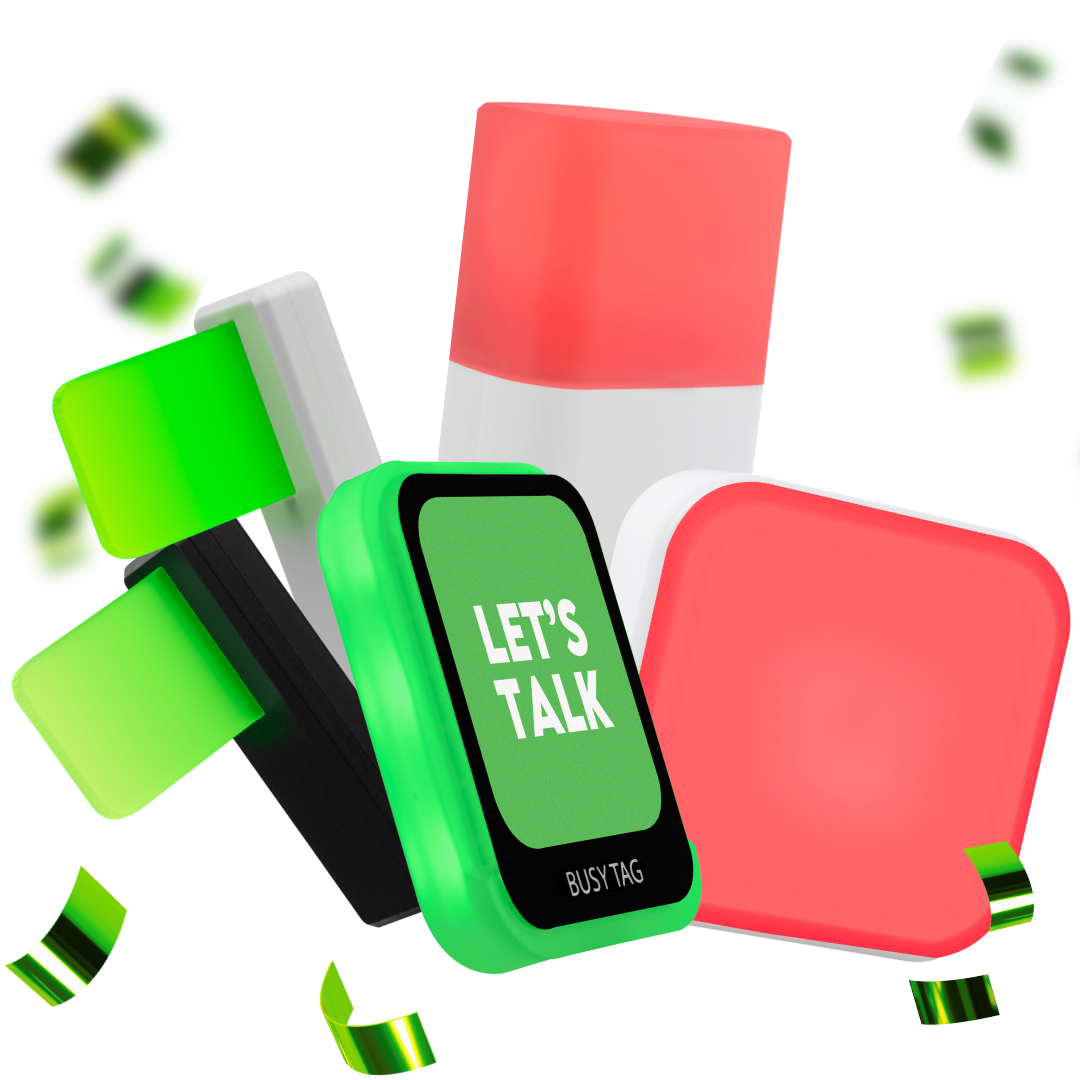
The Luxafor Flag and Luxafor Bluetooth are developed to indicate the user’s availability status using certain focus signals. The two smart office gadgets come with adjustable RGB profiles which correspond to the collaboration protocols (for instance, green = available, red = do-not-disturb, and blue = in-meeting). The LED focus lights states can be automated when the API of Luxafor controls the office productivity devices according to system events like booking a calendar, switching on focus mode, or detecting a call from Teams or Zoom platforms.
This feature resolves two failure points identified by Gallup directly:
- Shared expectations and guidelines are lacking. According to Gallup, only 62% of hybrid teams with a plan have rules for when team members should be present, and just 50% have rules for notifying others when they will be unavailable. Luxafor workplace communication tools, make these rules into visible, enforceable signals. Rather than depending on occasional messaging or making assumptions, colleagues can see a uniform, device-level focus signals that shows availability in real-time.
- Uncoordinated calendars that result in interruptions. According to Gallup data, teams that lack well-defined hybrid collaboration strategies are 2.2 times less likely to have good collaboration outcomes and they also suffer 29% more from burnout. One of the main causes is the high frequency of interruptions that are not controlled. The DND signal of a Luxafor device, when it is active, lowers the cognitive cost that is caused by random interactions. The workers are able to steer clear of unplanned interruptions because the device informs the status of the person working before the interruption takes place.
In large operations, visual availability lights eliminate barriers in collaboration areas, where hybrid groups usually have difficulties to coexist with different time intervals. Luxafor’s hardware-based indicators give a clear and visible layer which is not affected by the scenario that Gallup outlines: people opting for their own likes as against rules of the team.
Supporting deep work and focus
Luxafor office productivity devices can also act as local focus-management systems by linking up with task triggers, focus timers, and automation workflows using the Luxafor Software Suite and API. When the device goes into “focus mode,” it turns on a permanent red or custom-coded signal and at the same time, it may use the optional productivity functions like timely reminders or Pomodoro cycles.
This, in turn, supports directly the two Gallup findings which are most pertinent to performance and engagement:
- A well-planned hybrid working arrangement is associated with a 66% higher worker engagement rate. Workers’ participation rises when they have clarity on collaboration and the silence periods for their focused work activities are honored. Luxafor develops a visible rule around focus periods, which Gallup considers to be a necessary but frequently absent practice. Luxafor translates these rules into practice by signalling the quiet time in a manner that the whole team can correctly spot.
- Colleagues who keep on having discussions about hybrid-work see collaboration to the extent of 84% and engagement to the tune of 50%. Luxafor data signals are regular feedback loops in these conversations. The teams can analyze the trends: the frequency of DND activations by individuals, the number of meetings that cause auto-status changes, and whether the deep-work periods correspond to the collaboration objectives.
In short, Luxafor installs a micro-infrastructure for managing focus discipline. It is not just through software notifications that the hybrid workers rely heavily; the notifications are usually ignored by them due to alert fatigue. Luxafor has introduced a physical signaling modality which is difficult to overlook and is also straightforward to understand.
How Luxafor Devices Support Productivity and Team Awareness
For example, over the last year, the health of the managers has worsened, while the individual contributors have rated their lives a little higher, which shows that the supervisors are the ones who carry the burden of the coordination in hybrid settings to such an extent.
Luxafor gadgets facilitate the streaming of availability and focus states into the clear visual focus signals which, in turn, reduce the volume of clarifying messages, interruptions, and micro-coordination tasks that usually pile up on the managers.
Case Studies: Hybrid Teams Using Visual Signals
When the availability and focus states are stated through explicit, device-level signals instead of assumptions or platform-dependent status icons, hybrid teams acquire clarity that can be measured. The case studies presented below demonstrate how teams make use of these busy light indicators in order to minimize coordination friction, safeguard deep-work time, and establish more predictable collaboration routines.
Marketing team uses visual signals to protect deep-work time during in-office days
The hybrid marketing team remarked that the days spent in the office were very often unproductive because of spontaneous talks and ad-hoc demands. Even if the employees scheduled focus blocks, the absence of uniform visibility caused a lot of interruptions during content generation and analytics work.
Each workstation was provided with a Luxafor Flag device that had a three-color protocol:
- red meant deep work
- green meant available
- yellow was for short breaks or transitional work
The visual availability lights setup was operated manually with the device button and automatically through integrations with timer workflows. The staff followed common norms: red signals were respected absolutely, and “yellow” meant slight delays instead of complete unavailability.
After a few weeks, the team claimed to have more predictable deep-work cycles and less tiredness from switching of contexts. Also, the team planned more brainstorming and collaborative work sessions, and the members revealed that the in-office days were more structured and less cognitively exhaustive.
Cross-functional operations team improves hybrid meeting efficiency
The logistics, procurement, and inventory management operations team, which was cross-functional in nature, had a problem with the hybrid meetings starting on time due to unclear availability or transitions between tasks.
Webhook triggers were used to connect the Luxafor devices with the team’s shared meeting calendar. The device automatically changed to blue for each participant when a meeting’s start time was near, signaling that the participant was about to be unavailable, and this was a reminder for the respective team member to finish the open tasks.
This led to hybrid meetings starting more frequently on time, and the number of team members joining late due to the uncertainty of their colleagues’ task states was reduced. Although formal measurements were not taken, the team said that the visual layer helped to minimize the friction between the operational tasks and the collaborative sessions.
Choosing the Right Smart Light Setup for Your Office
When it comes to choosing smart lights for offices configuration that is efficient, one has to consider the device capabilities and the operational patterns of the workspace. The hybrid office is the one that gets to maximize the benefits from the deterministic and low-latency signaling desk status indicators as opposed to purely aesthetic lighting features.
The main evaluation criteria usually cover aspects like the compatibility of the protocol (USB, Bluetooth, Wi-Fi, or PoE), the reliability of updates under concurrent triggers, the visibility range in mixed-lighting conditions, and the depth of integration with existing hybrid work tools like calendars, focus timers, or room-booking systems. The best possible setup is the one that transforms real-time work states into easily perceivable optical cues, integrates with hybrid workflows, and consistently ensures visibility across changing office conditions.