Managing “Do Not Disturb” Culture in Open Offices and Remote Teams with Visual Status Lights

Image from Pexels
Office distractions are difficult to avoid, whether your employees come to remote team etiquette. However, they reduce productivity and make goals more difficult to achieve. As opposed to visual status indicators, From digital interruptions to physical disturbances, the modern workplace is full of distractions that keep employees from completing tasks and focusing.
As a manager, business owner, or leader, you must understand the impact of distractions on productivity and devise strategies to reduce them for your team. In this piece, we'll discuss frequent workplace distractions, the office communication boundaries, and how to reduce them.
The Challenge of Distractions in Modern Work Environments
Working from home has its ups and downs in terms of productivity but it also brings new distractions. As a result, some organizations that went back to the office after the pandemic are still working remotely or in a mixed way. Hence, managers have to take into account the effects of distractions on the output of their employees who work in various places.
In a typical office setup, the major distractions frequently come from the colleagues with whom one has unplanned conversations or the surrounding noise. In contrast, the workers at home have to deal with another assortment of distractions which include interruptions from family members, problems related to the house, and the absence of a proper working space.
Here’s what’s causing distractions today:
- Default to meetings over messaging: Teams continue to rely on sync calls to coordinate, even if async would be faster and less disruptive. Calendar overload becomes normalized.
- Tool creep and alert fatigue. Employees frequently use Slack, Teams, Notion, Zoom, and emails concurrently. Each platform brings value in its own right, but when combined, they increase distraction.
- Unbalanced hybrid setups: On-site staff must deal with noise and uncontrolled interaction. Remote team etiquette faces digital pings and meeting bloat. Neither side receives consistent attention.
- Lack of visibility into how time is actually spent: Managers cannot see the cost of these distractions without behavioral data. They simply sense it, whether in decreased output, missed deadlines, or nebulous disengagement.
That’s why the solution is more clear. Once managers understand where attention is slipping, they may rearrange procedures to protect it.
What Is a “Do Not Disturb” Culture and Why It Matters
Do Not Disturb (DND) culture is a workplace standard where uninterrupted focus time is recognized as a collective concern rather than an individual choice. It implies that employees officially accept that concentration needs safeguarding, and they make rules for communication, calling, and interruptions during certain times agreed upon beforehand. A DND workplace culture does not depend on personal limitations (“I assume they understand I’m busy”); on the contrary, it sets team-related norms that promote focus as the normal state, not the rare one.
A robust DND culture is essential as the modern workplace is filled with constant interruptions due to pings, chats, notifications, and last-minute demands which not only break but also deplete cognitive energy. Studies have demonstrated that even minor breaks can take several minutes to recover, impair working memory and decrease whole performance among the different complex tasks. When a team comes to an agreement on a no-interruption rule, three results materialize:
- Quality work because a person can maintain a good cognitive state long enough to reason and accomplish the task of importance.
- Workers experience less stress and burnout as they do not constantly have to switch from communicating reactively to working focusedly.
- More predictable collaboration since the teams know when to involve, when to wait, and how to escalate without breaking someone’s workflow.
A DND workplace culture is not about excluding people; it is about creating the conditions for everyone to perform their best, while collaboration becomes more intentional and less chaotic.
How Visual Status Lights Promote Respectful Communication
Our brains’ standard operating procedures involve receiving, sending, and interpreting the information through the means of pictures.
Thus, visual status indicators are the best in this aspect, and the office will be less chaotic and more organized. Communication methods that are heavy on visual elements have the following advantages:
- Increase Productivity: The main reason why a busy light for teams raise efficiency is that they reduce the number of interruptions and misunderstandings. When workers can easily discern each other’s availability or a project’s condition, they can then pick the best means and time of communication. This process results in better attention and higher output.
- Team Cooperation: Everyone will find it easier to work together if there are bright visual signs telling about the work process and the team’s availability. The team members can identify the time when they can work together and also avoid clashes in the schedule thus making the whole project smoother.
- Less Stress and Healthier Workers: People are less stressed at the workplace if there is good busy light for teams communication. That is because such communication minimizes misunderstandings and sets a nice flow to the workday. Once employees are aware of their coworkers’ availability and workload, they can better control the expectations around them and thus plan their work more efficiently.
The use of communication guidelines is very beneficial for workers who have different communication styles or for those who consider oral or written instructions as a challenge. With several options available for sharing information, offices can ensure their environment is more inclusive and accommodating to different needs and preferences.
Setting team rules and signals
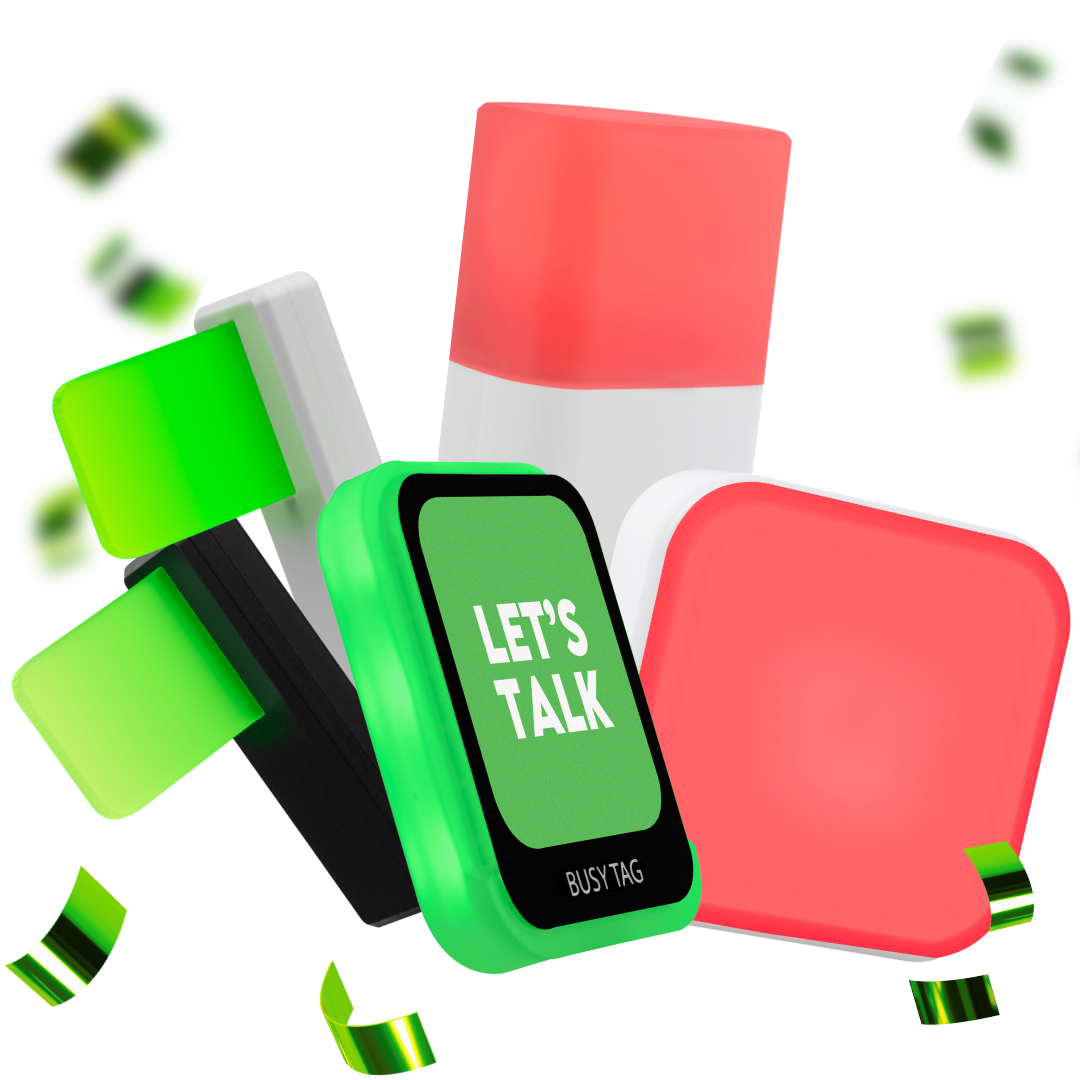
In order for Luxafor indicators to function to their fullest capacity, the teams have to agree on some rules that would clarify the meaning of each Do Not Disturb light state and when the employee should turn it on. In this way, Luxafor transforms from a private device into a team productivity signals communication system that is free of misunderstandings, minimizes distractions, and ensures that the time for deep work is not disturbed.
One finds that in case of discrepancies, a majority, or if all of these three principles characterize the organization’s work ethos, the organization will highly benefit from Luxafor.
Define each Luxafor color or pattern clearly.
The teams attribute universal meanings, for instance:
- Red = Do Not Disturb / Deep Work
- Blue = In a Meeting (virtual or in-person)
- Green = Available
- Yellow = Away or Transitioning Between Tasks
These regulations which are set are applicable to all Luxafor Flags, Bluetooth devices and software indicators so there is no need for anyone to speculate about the meaning of a light.
Use the signals consistently across the team.
Luxafor is dependable just in case everyone is using it the same way. Teams incorporate the changes of light into their daily activities. For example, they change it to red before bringing up the focus block, turn it to blue when they are in Zoom meetings, or switch it back to green when they are available for questions. Automatic synchronization via Slack, Teams or Zoom integrations removes any friction and ensures that updates are precise.
Respect the signals once they’re visible.
The system is only functional when the entire team adheres to it. If a coworker has their Luxafor interruption management set to red, the number of interruptions will be significantly reduced unless it is a matter of utmost urgency. This mutual discipline, in turn, prevents the occurrence of spontaneous micro-disruptions, keeps the flow of work going during difficult tasks, and earns trust between the team members regarding their use of focus time.
By applying common Luxafor regulations and regarding the signals as a part of the workplace culture, the teams shift from reactive work patterns to predictable and frictionless collaboration.
Examples of Luxafor Implementation in Open Offices
A content team uses the red color to designate writing or editing mode. When the authors turn on red, the coworkers know not to disturb them or pose “quick questions.” Interruptions reduce drastically during the campaign deadlines, and the writers claim they have longer periods without interruptions.
Developers integrate Luxafor with Microsoft Teams. Once the stand-up call begins, everyone’s gadget gets automatically set to blue, which means “in a meeting.” Visitors in the office can notice who is on live calls without needing to come closer.
The support staff use Luxafor in green while they are between tickets and ready for quick cooperation. They turn it to yellow while writing ticket notes and to red during live chats. This transparency helps to minimize pointless questions across desks.
Building Long-Term Productivity Habits in Hybrid Teams
Routines such as the ones that protect attention, reduce unnecessary communication load, and make collaboration more predictable, are the ones that sustain productivity in hybrid teams. Luxafor is the one that helps the teams build these routines by providing a consistent, visible layer of signals that allow uninterrupted work and reduce guesswork about one’s availability. If teams use these signals on a daily basis they will reinforce the patterns that make deep work easier to maintain.
In the long run, these routines transition from “focus management tools we use” to “how we work.” Workers are rewarded with more distinct limits, less context switching, and a healthier mix of focusing and communicating. Companies are rewarded with the higher quality of output, smoother interlocation coordination, and less stressed workers. By putting together the Do Not Disturb culture with simple Do Not Disturb light, hybrid teams are not only creating but are also sustaining long-term habits that will develop performance, support employee well-being, and provide manageability in the modern work environment for everyone.